Vendor Storage and Handling Disclosure Explained
By PepTables editorial ·
A vendor storage and handling disclosure is a written statement from a research peptide supplier describing the temperature range a product requires, the method used to protect it during shipping, and any dates tied to stability testing. It appears on product pages, in safety data sheets, or on dedicated policy pages. It is a documentation artifact that tells you what a vendor wrote down, not a set of instructions for how to store or handle a peptide yourself.
That distinction matters. Many pages online blur the line between "here is what the vendor published" and "here is how you should do this at home." This one sticks to the first.
What a Vendor Storage and Handling Disclosure Actually States
In plain terms, a vendor storage and handling disclosure is a documentation record. You locate it, evaluate it for completeness, and compare it against other vendor documents the same way you'd check a certificate of analysis or a safety data sheet.
It is not a set of instructions for you to follow. A complete disclosure shows that a vendor keeps organized batch documentation and is willing to put specifics in writing rather than leaving buyers to guess. An absent or vague one is a data point too - just a less reassuring one.
What this article covers: This page describes what a storage and handling disclosure states and where it typically appears. It does not provide storage, reconstitution, or handling instructions; it does not reproduce safety data sheet contents; it does not compare shipping costs; and it does not make any claim about product safety, efficacy, or regulatory approval.
The Four Elements of a Complete Disclosure
A thorough disclosure reads like a short technical note, not a marketing paragraph. Vague language like "store properly" or "keep cool" tells a buyer nothing verifiable. A disclosure earns the label "complete" when it states specific, checkable details across four areas.
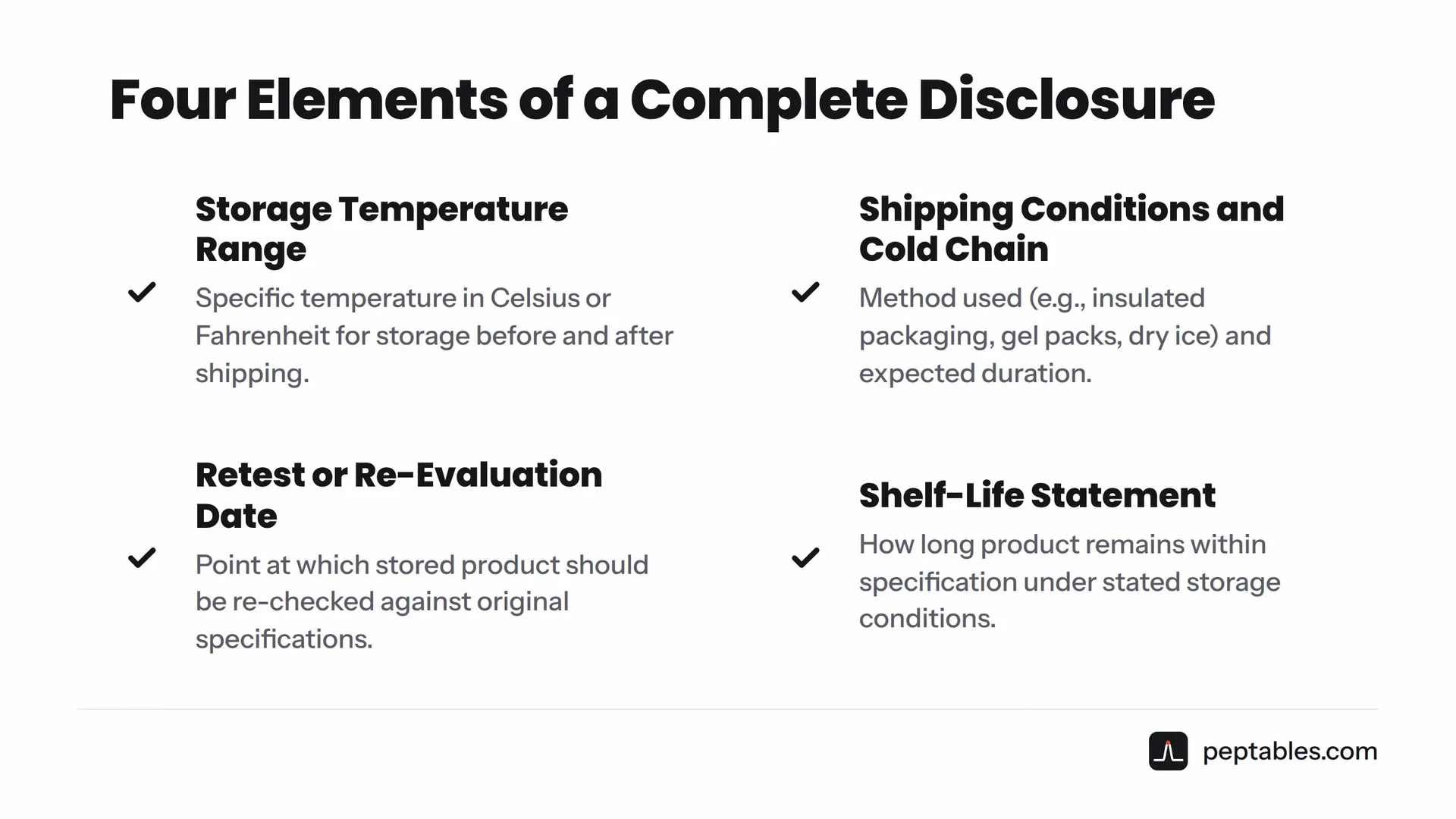
Storage Temperature Range
This is the specific range - usually in Celsius or Fahrenheit - that the vendor states the product should be kept within before and after shipping (for example, frozen, refrigerated, or room temperature). A disclosure that names an actual range gives a buyer something concrete to compare against the product's certificate of analysis or batch documentation. One that just says "keep cold" gives a buyer nothing to verify.
Shipping Conditions and Cold Chain
Cold chain refers to the unbroken sequence of temperature-controlled handling and transport a product moves through from manufacture to delivery. A disclosure that addresses shipping conditions should describe the method used - such as insulated packaging with gel packs or dry ice - and for how long that method is expected to maintain the stated temperature range in transit.
Retest or Re-Evaluation Date
A retest date (sometimes called a re-evaluation date) is the point at which a stored product should be re-checked against its original specifications before continued use. This is distinct from an expiration date, which marks when a product should no longer be used at all. When a disclosure names a retest date, it signals the vendor is tracking stability over time rather than treating the product as indefinitely stable.
Shelf-Life Statement
A shelf-life statement describes how long a product is expected to remain within specification when stored under the conditions the vendor describes. It is tied directly to the storage range named above. A shelf-life claim without a stated storage range is difficult to verify, since shelf life depends entirely on the conditions a product is actually kept under.
| Element | What It Tells a Buyer | Why It Matters for Documentation Review |
|---|---|---|
| Storage temperature range | The specific conditions the product should be kept within | Lets a buyer check consistency against the COA or batch records |
| Shipping method / cold chain | How the product was protected in transit | Shows whether temperature-sensitive handling was actually planned for |
| Retest or re-evaluation date | When stability should be rechecked | Indicates whether the vendor tracks stability over time |
| Shelf-life statement | How long the product is expected to stay in spec | Only meaningful when paired with a stated storage range |
Where Vendors Publish Storage and Handling Disclosures
Disclosures tend to appear in one of three places, and the location itself tells you something about how a vendor treats documentation.
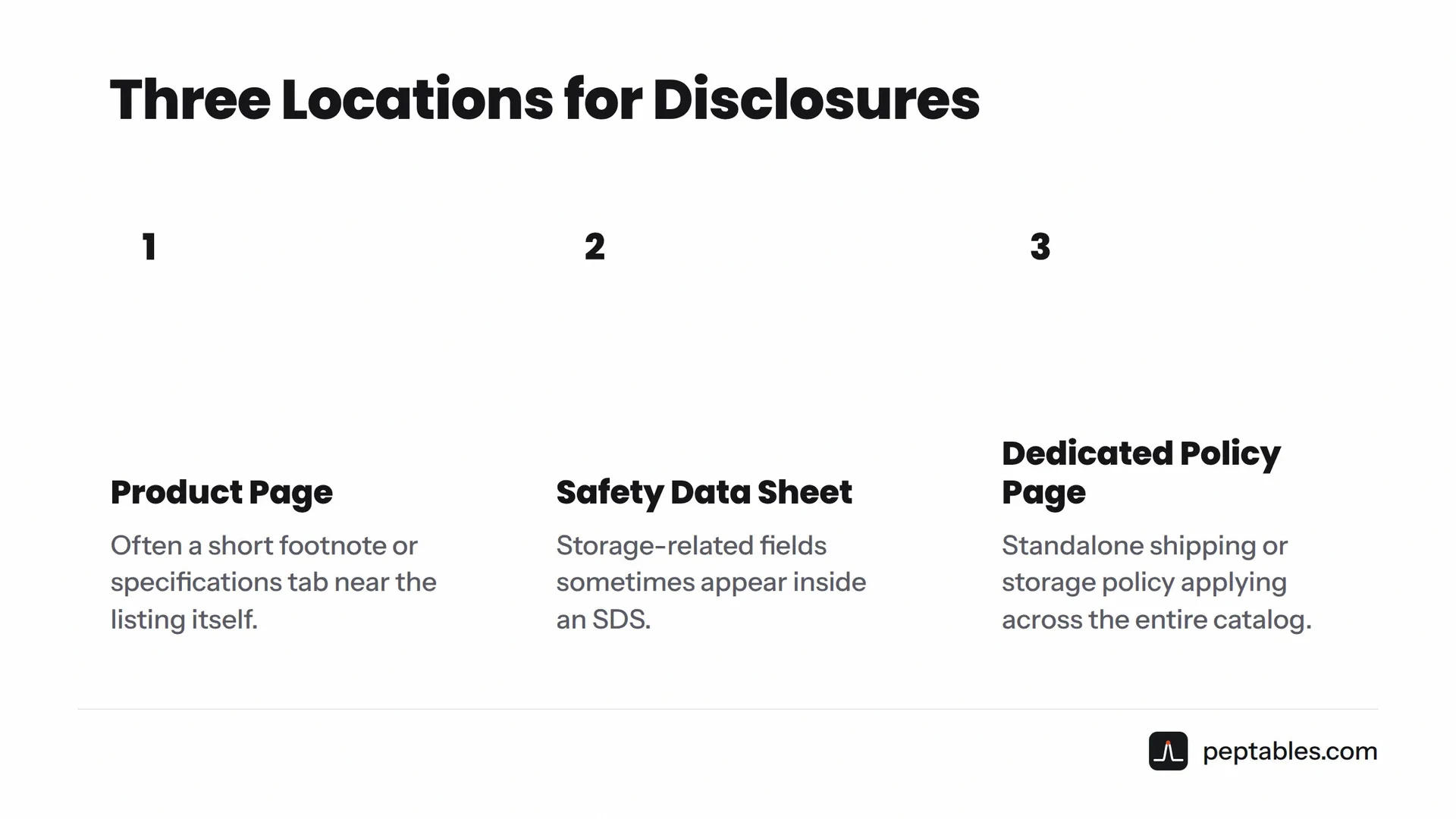
Product page. Often a short footnote or specifications tab near the listing itself, sometimes just a line or two.
Safety data sheet (SDS). Storage-related fields sometimes appear inside an SDS, though an SDS is built for hazard and handling information generally, not specifically for a buyer-facing storage disclosure.
Dedicated policy page. Some vendors maintain a standalone shipping or storage policy page that applies across their entire catalog rather than repeating the same statement on every product listing.
As a labeled hypothetical for illustration only: Vendor A includes a one-line footnote under a product's price stating a frozen storage temperature and ice-pack shipping. That is a product-page disclosure. Vendor B maintains a separate "Shipping & Storage" policy page describing cold chain packaging and a 12-month retest interval for all catalog items, but does not post this information on individual product listings. Both are disclosures; they just live in different places. Neither example describes a real vendor.
How to Check Storage and Handling Disclosures
PepTables' published methodology counts shipping terms as one input to its business transparency category inside a broader documentation review. The other elements above are not separate PepTables scoring fields. They are checks a reader can run on a vendor's pages: whether each of the four elements (temperature range, shipping/cold chain method, retest date, shelf-life statement) is present or absent, the page type it appears on, and the date of the observation.
This is a documentation-coverage exercise, not a safety or efficacy judgment. A vendor can have a complete, well-written vendor handling information statement and that tells you nothing about whether the underlying product is accurately labeled or fit for any particular use. It only tells you the vendor wrote the information down somewhere a buyer can check it.
Record the date of every observation, because vendor pages change. A disclosure noted on one date may be edited, removed, or expanded later, so dated observation language keeps the record honest.
Storage Disclosure vs. Other Vendor Documents
Buyers often conflate a vendor storage and handling disclosure with other documents a vendor might publish. Each serves a different purpose.
| Document | Purpose | Typical Location | What It Does NOT Tell You |
|---|---|---|---|
| Storage & handling disclosure | States intended storage conditions, shipping method, and relevant dates | Product page, SDS, or policy page | Hazard classification, purity results, or shipping cost |
| Safety data sheet (SDS) | Describes hazard classification, handling precautions, and emergency information | Dedicated SDS document, often linked from the product page | Batch-specific purity, retest dates, or pricing |
| Certificate of analysis (COA) | Reports batch-specific test results such as purity and identity | Attached to the product page or sent on request | Shipping method or hazard data |
| Shipping cost statement | States what a buyer pays for shipping and expected delivery timing | Checkout page or shipping policy page | Storage conditions, batch traceability, or stability data |
Related Documentation to Review
A storage and handling disclosure is one piece of a larger documentation picture. Reviewing it alongside the vendor's other documents gives a fuller view of how a vendor handles paperwork:
- Safety data sheets - for hazard and handling information, separate from buyer-facing storage statements.
- Certificates of analysis - for batch-specific test results.
- Shipping or storage policy pages - for statements that apply across a vendor's whole catalog.
- Missing documentation - for what it means when a vendor publishes none of this at all.
If you're checking a vendor's page right now and trying to decide whether what you're looking at counts as a complete disclosure, the fastest next step is to run through the four elements above.
Frequently Asked Questions
Is a storage and handling disclosure the same as a safety data sheet?
No. An SDS covers hazard classification and handling precautions generally. A storage and handling disclosure is narrower, focused specifically on temperature, shipping method, and stability-related dates. It sometimes appears inside an SDS but doesn't have to.
Is a storage and handling disclosure the same as a certificate of analysis?
No. A COA reports batch-specific test results like purity and identity. A storage and handling disclosure says nothing about test results. It describes conditions and dates, not analytical outcomes.
Does this page tell me how to store or handle a peptide?
No. This page describes what a disclosure states and where to find it. It does not provide storage, reconstitution, or handling instructions of any kind.
What should I do if a vendor discloses nothing about storage or shipping?
Treat it as unknown, not an automatic red flag and not a point in the vendor's favor. Compare that gap against the rest of their documentation using the four elements above.
Does a complete disclosure mean the product is safe or effective?
No. A documentation score reflects whether information was published and where, not whether a product is safe, effective, or approved for any use. Treat documentation completeness and product safety as two separate questions.
Are there regulations requiring vendors to disclose storage and handling conditions?
Requirements vary by product classification and jurisdiction. Rather than assert a requirement without a dated source, we recommend checking directly with a relevant regulatory body for your situation. The U.S. Food and Drug Administration publishes general guidance on research-use and labeling topics that may be a useful starting point.