In-House vs Third-Party Peptide Testing: Key Differences
By Blogr ·

In-house testing means a peptide vendor tests and reports on its own product. Third-party testing means an independent lab receives a sample, tests it, and issues the report under its own name. The distinction is about who signs the paperwork - not automatically about whether the numbers are true or false. What matters is whether the report names its source, includes a test date, and labels its origin clearly enough that a reader can see which model produced it.
That sounds simple until you're looking at a Certificate of Analysis with no lab name, trying to decide whether the results mean anything at all. This guide treats in-house vs third-party testing strictly as a documentation question: what each model typically records, how PepTables scores report documentation, and what to ask when a vendor only has in-house data. It does not rule on whether in-house testing is "safe enough" or whether a particular lab has a conflict of interest - those are separate questions outside this guide.
What Each Term Actually Means
Both describe who performed the analysis and produced the report, not whether the work is reliable.
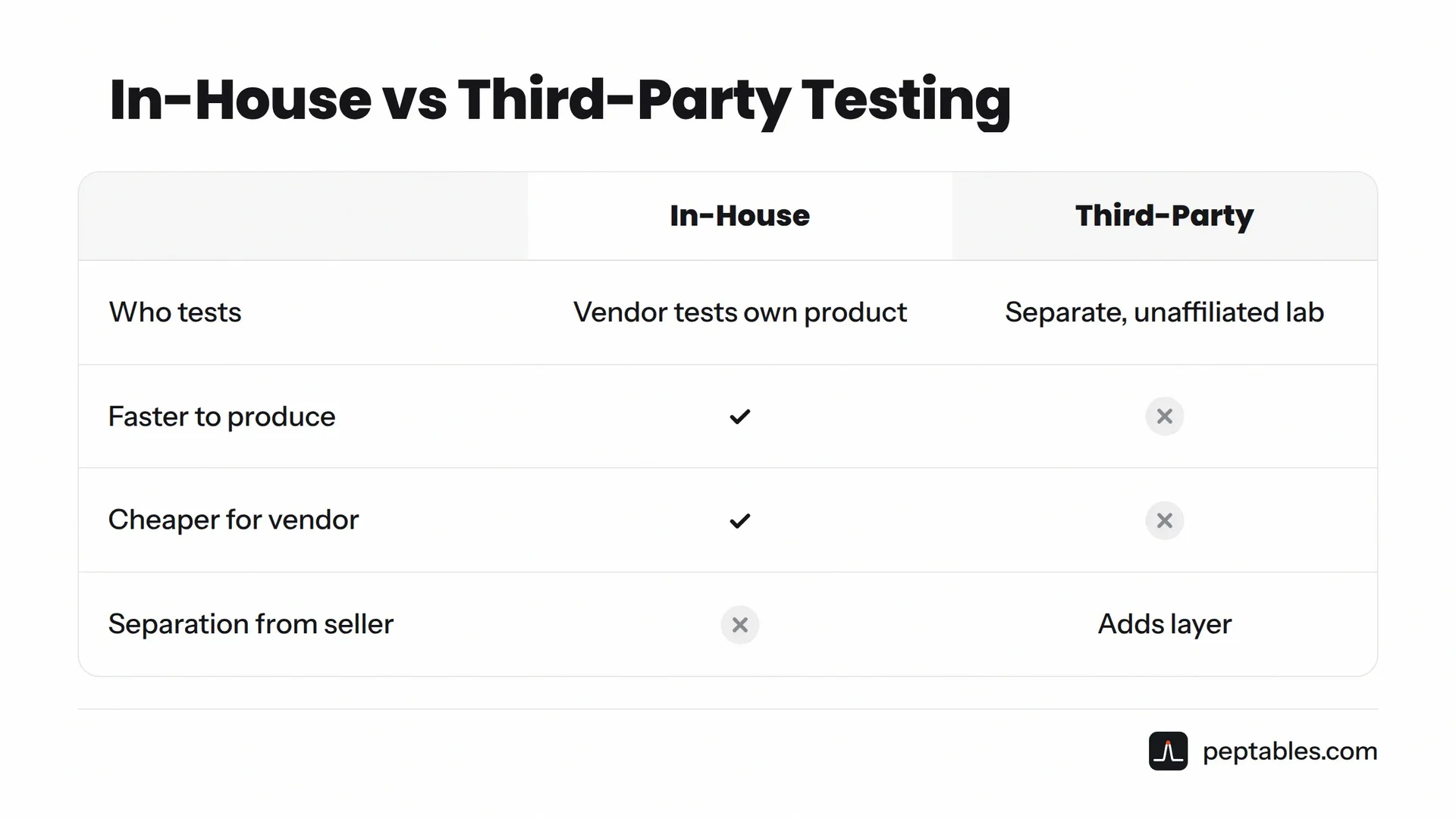
In-house testing happens when the manufacturer, supplier, or seller of a peptide tests its own product using its own equipment and staff, then issues its own report. The company that made the batch is the company that verified it. The report might include a batch number, test date, and named method like HPLC/MS, but the lab and the business selling the product are the same entity.
Third-party testing happens when a sample goes to a separate, unaffiliated laboratory with no ownership stake in the product. That independent lab runs its own analysis and returns a report under its own name. The vendor submitted a sample but did not perform the test itself.
Quick comparison:
- In-house: Faster and cheaper for the vendor to produce. The tester and the party profiting from a positive result are the same.
- Third-party: Adds a layer of separation between the business and the result. Does not automatically prove the exact sample submitted matches what reaches a buyer.
What Each Model Typically Documents
The difference shows up in what fields appear on the paperwork:
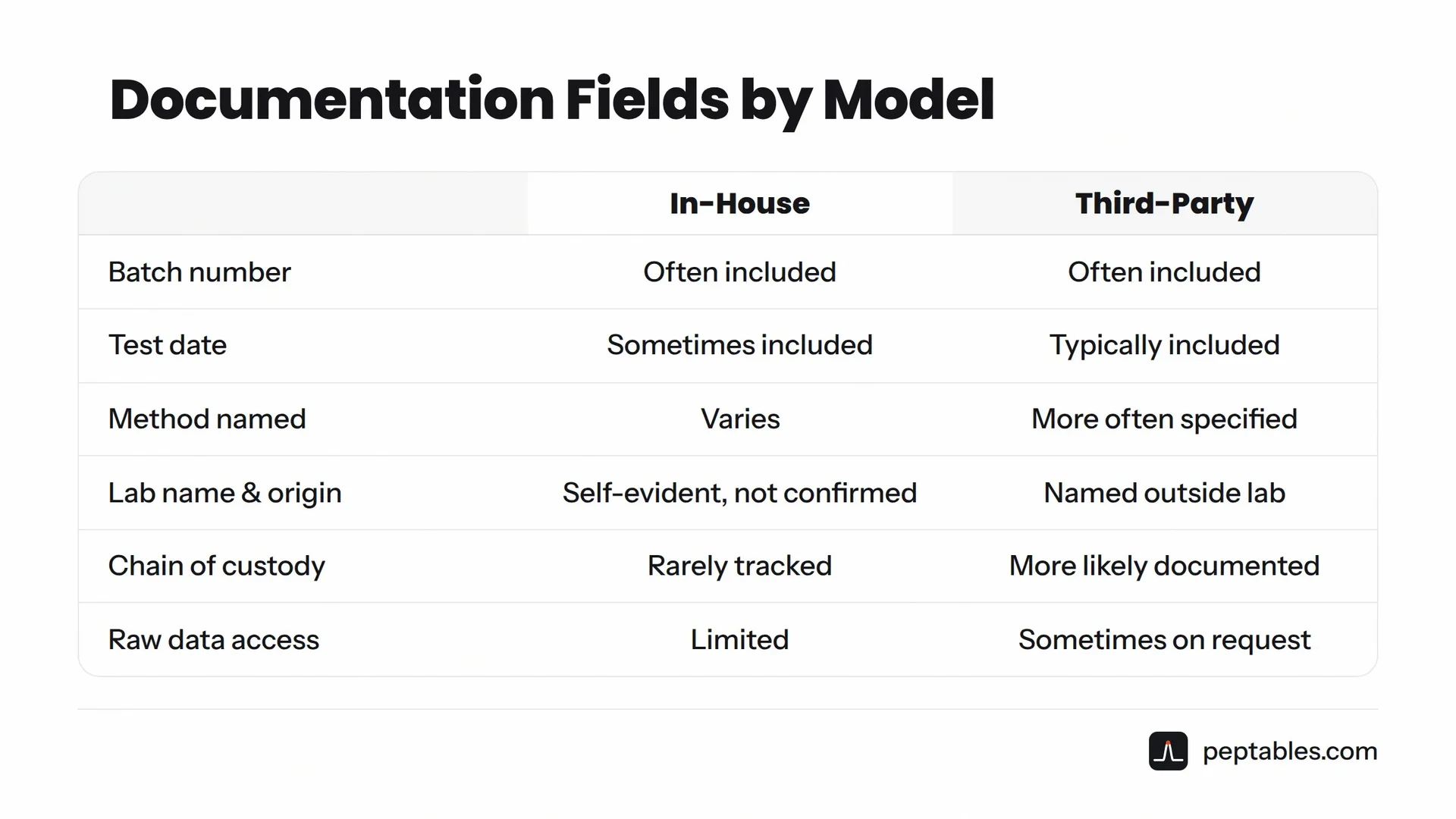
| Documentation Field | In-House Testing | Third-Party Testing |
|---|---|---|
| Batch number | Often included, assigned by the manufacturer | Often included, tied to the submitted sample |
| Test date | Sometimes included; format varies | Typically included, standardized by the lab |
| Method named (e.g., HPLC/MS) | Varies; may not be specified | More often specified, since labs document their own methods |
| Lab name and origin labeling | The vendor itself is the "lab"; origin is self-evident but not independently confirmed | A named outside lab appears on the report, separate from the seller |
| Chain of custody | Rarely tracked beyond internal records | More likely to include documented chain of custody from submission to result |
| Accessibility of raw data | Usually limited to what the vendor publishes | Sometimes available on request from the lab |
A report missing a batch number or test date is weak documentation no matter which model produced it. A complete in-house report can be more informative than a third-party report with blanks.
How PepTables Scores Report Documentation
PepTables does not score reports as in-house or third-party. Its published 100-point evidence rubric (v1.0) awards points for visible documentation: attributed certificate records and linked laboratory verification pages, lot-level batch traceability, business transparency, and how recently a source was observed. Each record in its report library shows the vendor, the laboratory, a source observation date and the type of link provided, and the library has a "Lab not identified" filter. An observation date is not a test date, and PepTables does not independently authenticate imported test results.
Rubric note: This is a documentation score, not a safety or efficacy judgment. A high documentation score means more of the paperwork is visible and traceable. It does not mean a product is safe, effective, or approved for any use. PepTables does not provide dosing, treatment, or human-use guidance.
The real failure mode in peptide documentation is not "in-house testing exists" - it is undisclosed origin. A report presented without any indication of who ran it creates the actual problem. Readers can address that by checking the origin of each report themselves, without needing a verdict on which model is inherently better.
What Each Model Can and Cannot Establish
In-House Reports
An in-house report, when sourced and dated, can establish that the vendor tested a specific batch on a specific date using a named method. What it generally cannot establish on its own is independent confirmation - the same party that sells the product also produced the number. A reader cannot tell from the document alone whether the tested sample matches what ships.
Third-Party Reports
A third-party report can establish that an outside party separate from the seller analyzed a submitted sample and returned a result under its own name, which adds separation absent from in-house-only documentation. What it generally cannot establish without additional verification is that the exact vial a buyer receives came from the same batch as the sample originally submitted. That gap is why chain of custody language matters when it appears.
Key trade-offs:
- Verifiability: A named outside lab is easier to contact and confirm directly than an internal department.
- Labeling by origin: Either model can be documented well or poorly; the label matters as much as the model.
- Format consistency: Outside labs tend to issue standardized reports. In-house reports vary vendor to vendor.
- Speed and cost: In-house testing is typically faster and cheaper for the vendor, which explains why it still appears often.
How to Read Either Type of Report
Regardless of which model produced it, use the same checklist. Before trusting any Certificate of Analysis:
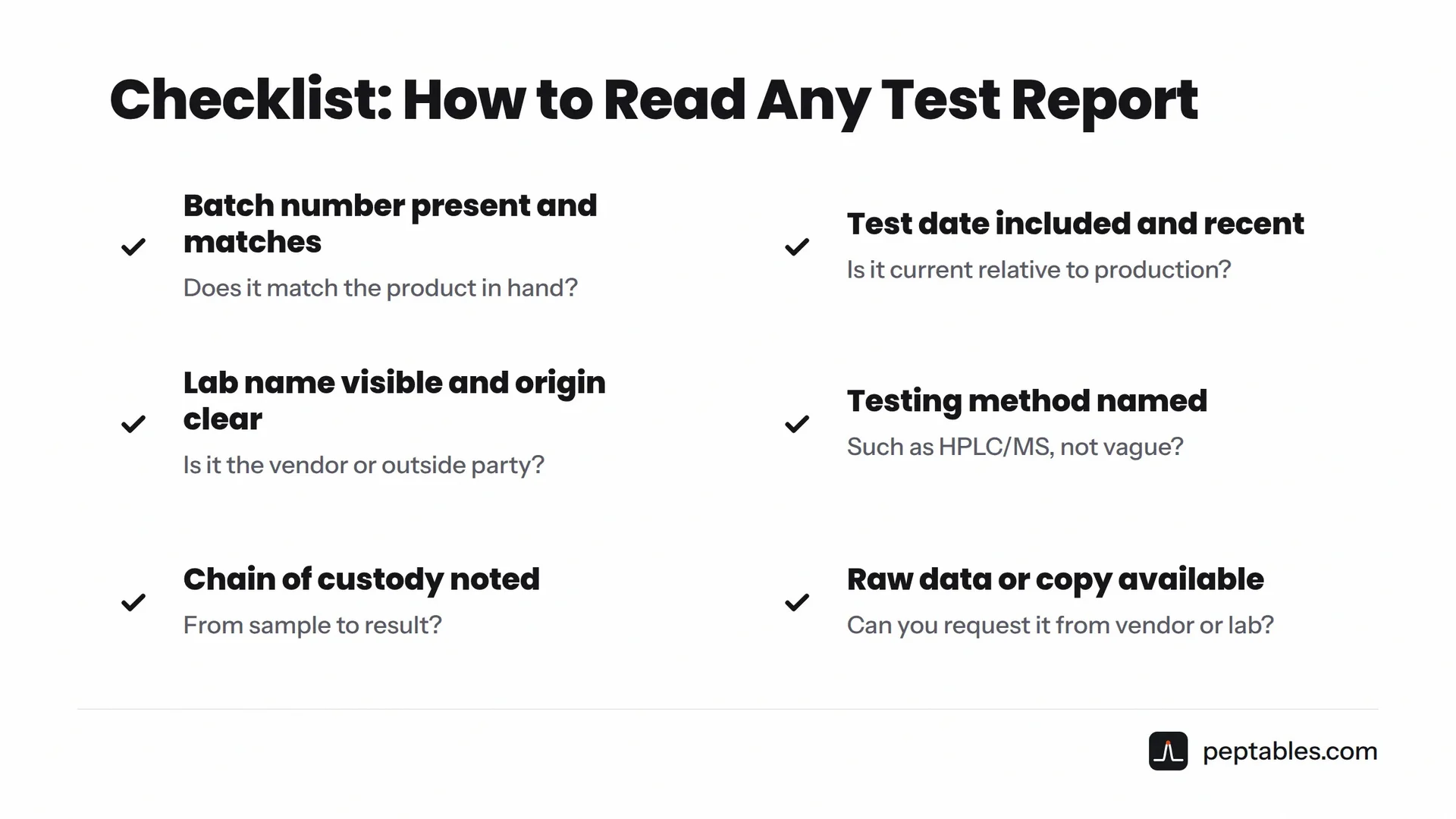
- Is a batch number present and does it match the product in hand?
- Is a test date included, and is it recent relative to production?
- Is the lab name visible, and is it clear whether that lab is the vendor itself or an outside party?
- Is the testing method named, such as HPLC/MS, rather than left vague?
- Is there any indication of chain of custody from sample to result?
- Can the raw data or a copy of the report be requested directly from the vendor or the lab?
If a report fails several checks, treat it as weak documentation regardless of whether it is in-house or third-party.
Questions to Ask When a Vendor Only Shows In-House Data
When a vendor can only show in-house documentation, the goal is not to reject it but to ask sharper questions about what it proves:
- Does the report include a batch number that matches the product you are looking at?
- Is there a test date, and how close is it to the product's production or listing date?
- Does the vendor name the testing method used, such as HPLC/MS, rather than just stating "tested"?
- Will the vendor confirm in writing that the tested sample came from the same batch being sold?
- Has the vendor ever submitted the same batch to an outside lab, and will they share that history?
- Is the report labeled clearly as in-house, or is the origin left ambiguous?
- Will the vendor provide raw data or a more detailed report on request?
None of these questions require declaring in-house testing untrustworthy. They apply the same documentation standard to every claim.
Frequently Asked Questions
What does "third-party tested" mean? An outside, unaffiliated laboratory separate from the manufacturer or seller received a sample and issued its own independent report.
Is in-house testing automatically less trustworthy? No. An in-house report that is sourced, dated, and clearly labeled by origin can serve as useful documentation. The concern is whether the report discloses who produced it and includes the fields needed to trace it to a specific batch.
What should a sourced and dated report include? At minimum: a batch number, a test date, a named testing method such as HPLC/MS, and a clear indication of which lab or party produced the results.
How can I tell who produced a test report? Look for a lab name and origin label on the document itself. If no outside lab is named, treat the report as in-house unless the vendor states otherwise in writing.
Does PepTables label reports as in-house or third-party? No. Its report library lists each record's vendor, laboratory, source observation date and link type, and offers a "Lab not identified" filter, so the reader still needs to check who ran the test.
Next Steps
This comparison stops at documentation on purpose. Questions about whether a specific lab is genuinely independent, how conflicts of interest between vendors and labs can shape results, or what accreditation standards like ISO 17025 actually require are outside the scope of this guide. For the broader picture of how batch records, Certificates of Analysis, and vendor disclosures fit together, start from the PepTables homepage.
If you are evaluating a specific vendor's claims right now, the fastest next step is running their documentation through the checklist above. It applies every field discussed here - batch number, test date, method, lab name, and origin labeling - to one vendor at a time so you are not guessing at what a report does and does not establish.