Endotoxin and Sterility Testing for Peptides Explained
By Blogr ·
Research peptide buyers typically receive a purity percentage on a Certificate of Analysis. Endotoxin and sterility results appear far less often on the same documents, creating a documentation gap that leaves many researchers guessing about two of the three critical questions: Is it pure? Is it free of bacterial toxins? Is it free of living contaminants?
This guide defines each test separately, explains how they differ from one another, and clarifies why a missing result should be read as unknown rather than failed.
Important disclaimer: Nothing here is a safety, efficacy, or suitability claim. Documentation presence or absence reflects what a vendor has chosen to disclose. It does not indicate whether a peptide is safe to handle or use. This page covers definitions and disclosure patterns only, not conclusions about risk.
The Three Questions Each Test Answers
Endotoxin testing and sterility testing address two distinct questions about a research peptide batch, separate from what purity testing reveals:
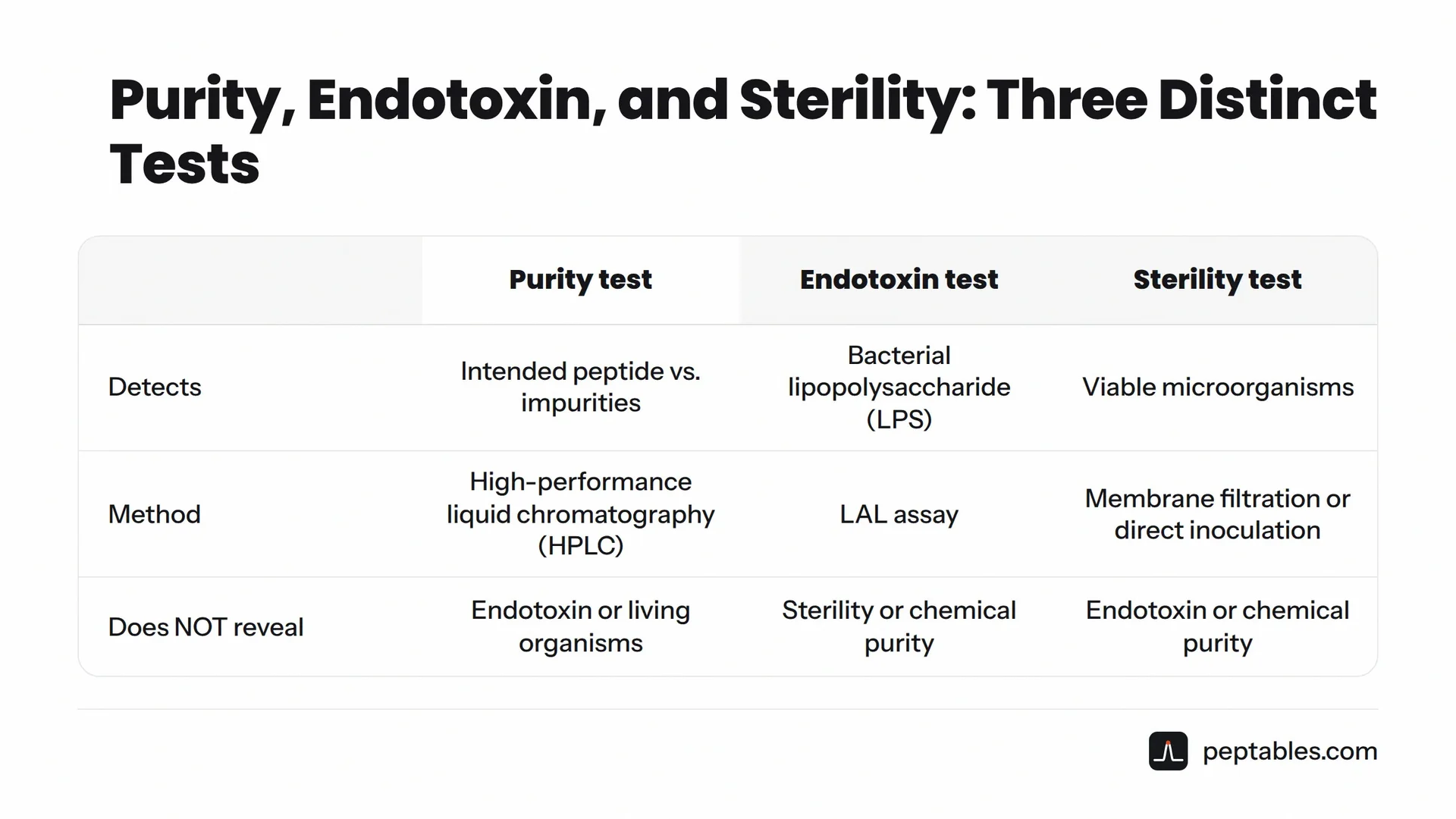
- Endotoxin test: detects bacterial lipopolysaccharide (LPS), a toxin fragment from the outer membrane of gram-negative bacteria, and expresses the result in endotoxin units per milliliter (EU/mL).
- Sterility test: detects the presence of any viable microorganism (bacteria, fungi, or yeast) capable of growth in culture media.
A peptide can pass one test and fail or never undergo the other. A solution free of living bacteria may still contain endotoxin residue because endotoxin is a molecular fragment, not a living cell. Neither test substitutes for an HPLC purity test, which measures how much of the material is the intended peptide versus degradation products or synthesis byproducts. Purity, endotoxin, and sterility are three independent assessments, and a Certificate of Analysis answering one has not answered the others.
Understanding Bacterial Endotoxin Testing
What endotoxin is
Endotoxin is the lipopolysaccharide component of the outer cell wall in gram-negative bacteria. It releases when bacteria die or multiply and persists in solution even after living bacteria have been filtered or killed. This persistence is why endotoxin testing exists as a separate requirement rather than being folded into general sterility testing.
The LAL assay
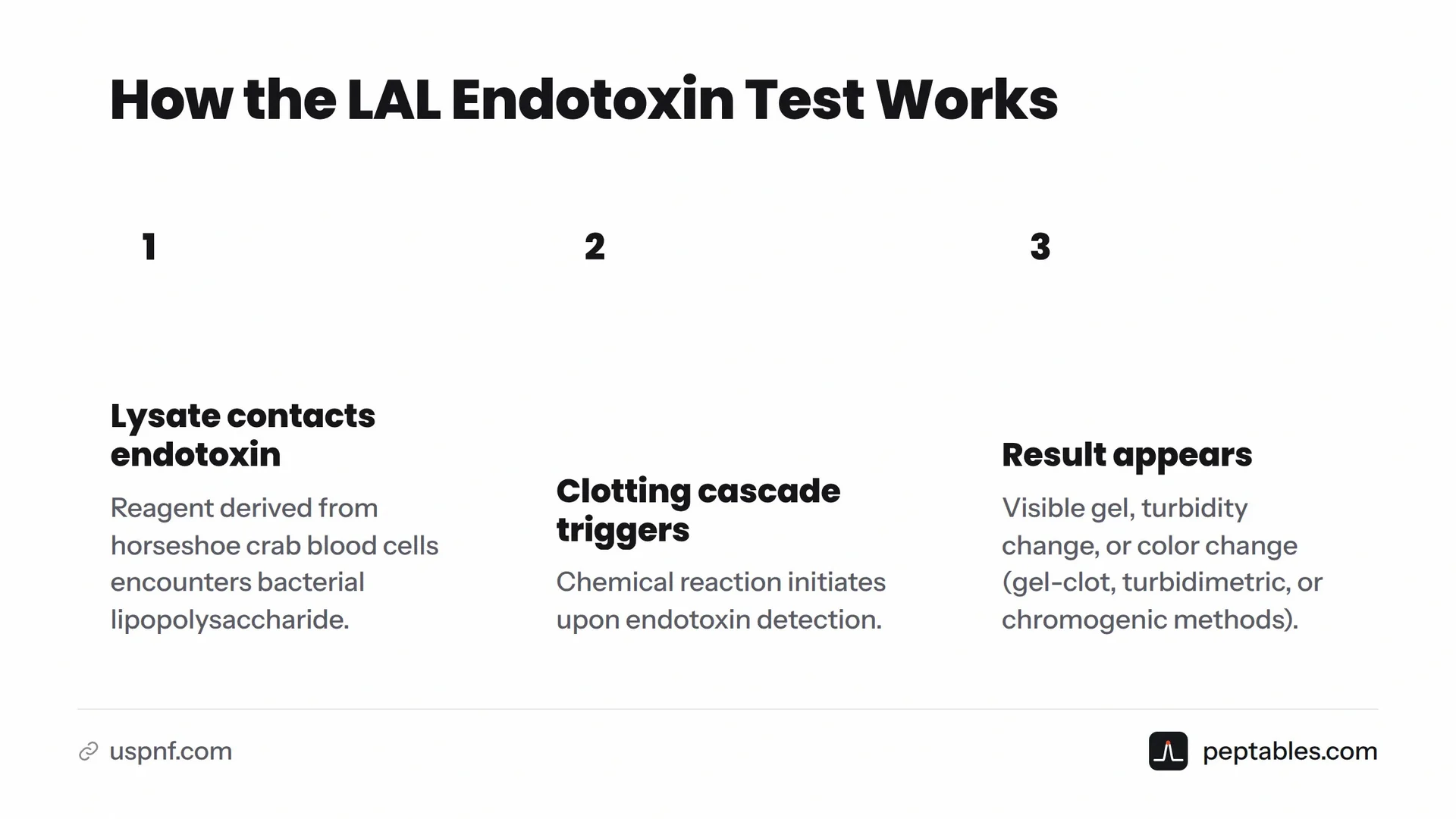
The Limulus Amebocyte Lysate (LAL) test is the most common method for detecting bacterial endotoxin. It uses a reagent derived from the blood cells of the Atlantic horseshoe crab, Limulus polyphemus. When the lysate contacts even trace amounts of endotoxin, it triggers a clotting cascade. Depending on the variant used, this produces a visible gel, turbidity change, or color change (gel-clot, turbidimetric, or chromogenic methods). The U.S. Fish and Wildlife Service has documented the biomedical industry's long-standing reliance on horseshoe crab blood, which has spurred research into recombinant alternatives.
How results are reported
The United States Pharmacopeia establishes the compendial standard for LAL testing in General Chapter <85>, Bacterial Endotoxins Test. Results are expressed in endotoxin units per milliliter (EU/mL), a measure of biological activity calibrated against a reference standard, not a weight or volume measurement. A lower EU/mL value indicates less endotoxin activity detected in the sample.
Understanding Sterility Testing
What sterility means in testing
Sterility means the absence of any viable, culturable microorganism when a sample is incubated under conditions favorable to microbial growth. It is a broader check than endotoxin testing because it looks for living organisms generally rather than a specific toxin from one bacterial class.
Common sterility test methods
Two methods dominate:
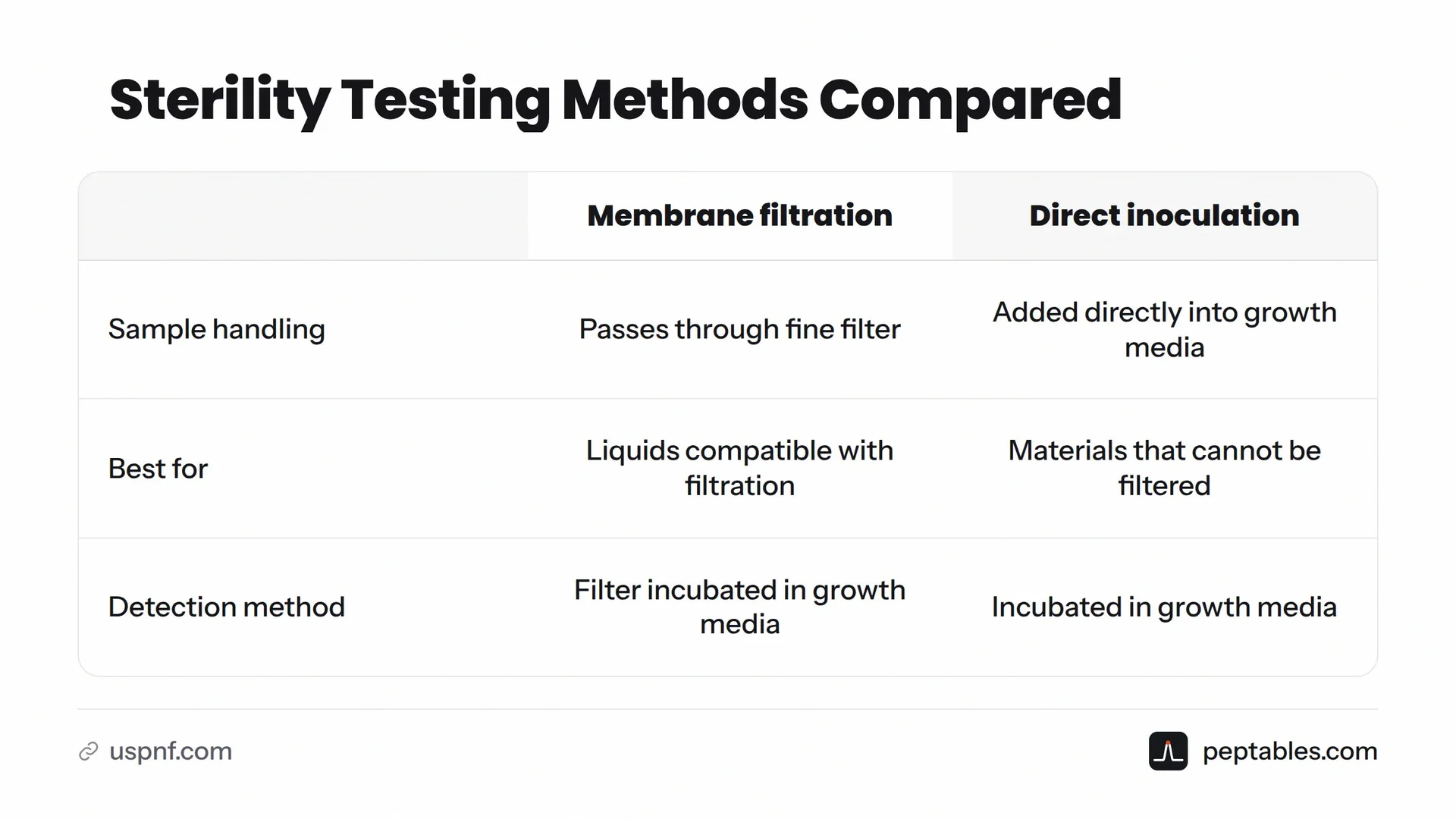
- Membrane filtration: the sample passes through a filter fine enough to trap microorganisms, and the filter is then incubated in growth media to see if anything grows.
- Direct inoculation: the sample is added directly into growth media and incubated, relying on the media to support any organisms present.
Membrane filtration is generally preferred for liquids compatible with filtration, while direct inoculation is often used for materials that cannot be filtered without loss or inhibition of recovery.
The compendial standard
The United States Pharmacopeia's General Chapter <71>, Sterility Tests describes standard procedures, incubation periods, and media requirements for both methods. It is the reference most third-party testing labs cite when reporting sterility results.
An important distinction: passing a sterility test does not automatically mean a sample is free of endotoxins. The two tests detect different things.
How These Tests Differ From Purity Testing
Purity, endotoxin, and sterility testing are sometimes grouped as though they were interchangeable quality checks. They are not. Each uses a different method, references a different standard, and answers a question the others cannot:
| Test type | What it detects | Common method | Standard referenced | What it does NOT tell you |
|---|---|---|---|---|
| Purity test | Concentration of the intended peptide versus impurities or degradation products | High-performance liquid chromatography (HPLC) | Method-specific, not a single USP chapter | Whether bacterial endotoxin or living microorganisms are present |
| Endotoxin test | Bacterial lipopolysaccharide (LPS) concentration, in EU/mL | LAL assay (gel-clot, turbidimetric, or chromogenic) | USP General Chapter <85> | Whether the sample is sterile, or how pure the peptide itself is |
| Sterility test | Presence of any viable microorganism (bacteria, fungi, yeast) | Membrane filtration or direct inoculation | USP General Chapter <71> | Endotoxin levels, or the chemical purity of the peptide |
Think of it this way: purity asks "How much of this is the peptide I ordered?", endotoxin asks "How much bacterial toxin residue is present?", and sterility asks "Is anything alive in here?" A Certificate of Analysis can answer any one without answering the other two.
Documentation Gaps in the Market
Purity percentages appear on the vast majority of research peptide Certificates of Analysis. Endotoxin and sterility results appear on far fewer.
The U.S. Food and Drug Administration recognizes that bacterial endotoxin testing is a standard expectation for parenteral drug products and medical devices contacting the bloodstream or cerebrospinal fluid, as outlined in its guidance on pyrogen and endotoxins testing. That expectation applies to regulated pharmaceutical products, not to research-use-only (RUO) peptides, which sit outside that regulatory framework entirely.
Because RUO peptides are not sold as drugs, no uniform requirement forces vendors to publish endotoxin or sterility results on every Certificate of Analysis. Some vendors run these tests but do not publish them. Some run them only on select batches. Some do not run them at all. Without a disclosure standard across vendors, a blank field tells a reader very little about what actually happened behind the scenes.
Why a Missing Result Means "Unknown," Not "Failed"
When a Certificate of Analysis has no endotoxin or sterility line, PepTables labels that field "unknown" rather than "failed," "not tested," or "clean." This choice reflects the reality of what a blank field can mean:
- The vendor never ran the test on that batch.
- The vendor ran the test but chose not to publish the result on the public-facing Certificate of Analysis.
- The lab issuing the Certificate of Analysis does not offer that test as part of its standard panel.
- The document provided was partial or excerpted from a longer report.
None of those scenarios equals "this peptide failed an endotoxin or sterility test." Labeling an absence as "failed" would invent a result that was never produced. "Unknown" is the honest descriptor for "we do not have this data," and it leaves room for a vendor to add documentation later without the label implying anything negative happened.
This labeling choice is also a trust decision. A documentation score built on invented pass/fail assumptions would be actively misleading. A score that says "here is exactly what is and is not disclosed" gives readers an honest starting point for their own due diligence, which is different from a safety rating.
Next Steps for Documentation Review
This guide intentionally stays narrow on definitions and disclosure patterns. For related topics, see:
- For HPLC purity interpretation, see the guide on reading purity percentages on a peptide COA.
- For an overview of different Certificate of Analysis formats from labs, see the guide on peptide testing report types.
- For the distinction between a documentation score and a safety rating, see why a documentation score is not a safety rating.
- For a checklist of what to verify before trusting a vendor's testing claims, see the testing claims checklist.
- For the full picture of how PepTables organizes testing documentation across vendors, start at the peptide testing documentation hub.
For deeper technical detail on endotoxin method validation, STERIS Applied Sterilization Technologies has published a detailed session on bacterial endotoxin test methods: https://www.youtube.com/watch?v=rqWGhLdm-oE
Frequently Asked Questions
What is an endotoxin test for peptides?
A laboratory test that measures bacterial lipopolysaccharide concentration, typically using the LAL assay, and reports the result in endotoxin units per milliliter (EU/mL).
What is a sterility test for peptides?
A laboratory test that checks for the presence of any viable microorganism (bacteria, fungi, or yeast) in a sample, typically using membrane filtration or direct inoculation followed by incubation.
What does LAL stand for and how does it work?
LAL stands for Limulus Amebocyte Lysate, a reagent derived from horseshoe crab blood cells that reacts with bacterial endotoxin to produce a detectable clot, color change, or turbidity change.
What is USP <85>?
USP General Chapter <85> is the United States Pharmacopeia's compendial standard for how the Bacterial Endotoxins Test should be performed and interpreted.
What is USP <71>?
USP General Chapter <71> is the United States Pharmacopeia's compendial standard for how sterility testing should be performed, including membrane filtration and direct inoculation procedures.
What does EU/mL mean on a COA?
EU/mL stands for endotoxin units per milliliter, the standard unit for reporting the concentration of bacterial endotoxin activity detected in a liquid sample.
Is an endotoxin test the same as a purity test?
No. A purity test, usually HPLC, measures how much of a sample is the intended peptide versus impurities. An endotoxin test measures bacterial toxin residue and tells you nothing about chemical purity.
Why don't all peptide COAs show endotoxin or sterility results?
Research-use-only peptides fall outside the regulatory framework that requires these tests for pharmaceutical products. Vendors are not uniformly required to run or publish them, so practices vary widely.
Does a missing endotoxin result mean the peptide failed testing?
No. A missing result means the data was not disclosed on that document. It does not confirm the test was run and failed, run and passed, or never run at all, which is why PepTables labels it "unknown."
Where can I check if a vendor documents endotoxin and sterility testing?
Start with the vendor's published Certificate of Analysis. Cross-reference it against the PepTables peptide testing documentation hub, which shows what each document actually discloses.